 how-to
How to Clean Post Construction Dust: 7-Step Guide
Last Updated: October 23, 2026
Quick Summary
To clean post construction dust, wear an N95 or P100 respirator, then remove debris and clean the air with ventilation and HEPA filtration before wiping surfaces. Work top to bottom: ceilings, walls, then floors, using a sealed HEPA vacuum and damp microfiber cloths instead of dry-sweeping construction dust.
- Seal off rooms you are not cleaning yet with plastic sheeting over doorways.
- A true HEPA filter captures 99.97% of particles at 0.3 microns in a sealed system.
- Empty the vacuum canister when it is about half full to keep airflow strong.
- Most homes need repeat cleaning over the first one to two weeks after construction.
- Call a pro if dust keeps returning after two full weeks of scheduled passes.
Table of Contents
- Before You Start: Safety Gear and Setup for Construction Dust
- Your Post-Construction Cleaning Checklist, Phase by Phase
- How to Remove Construction Dust From the Air
- Picking the Best Vacuum for Construction Dust
- Top-to-Bottom Cleaning: Ceilings, Walls, Floors, and Glass
- How Long Does Construction Dust Last, and How Do You Know You're Done?
- DIY or Hire a Professional Post-Construction Cleaning Service?
- Frequently Asked Questions
Before You Start: Safety Gear and Setup for Construction Dust
Construction dust is not ordinary house dust. It is a mix of drywall powder, silica, sawdust, and paint residue, and the fine particles hang in the air for hours. Learning how to clean post construction dust starts with protecting your lungs, not your floors.
At LSC Omaha Cleaning, we treat safety as step one on every post-construction job. Here is what to wear and set up before you touch a broom:
- N95 or P100 respirator fitted over your nose and mouth
- Safety glasses to keep dust out of your eyes
- Nitrile gloves for handling debris and cleaning solutions
Seal off rooms you are not cleaning yet. Tape plastic sheeting over doorways so fine dust does not drift into clean spaces.
Protect Yourself From Silica and Drywall Dust
Drywall dust and silica particles are the real hazard here. The OSHA silica dust guidance explains that repeated exposure to respirable crystalline silica can damage lung tissue. Sanding joint compound and cutting concrete both release these particles.
Keep these rules in mind:
- Wear your respirator the entire time you are dry, dusty work
- Never dry-sweep heavy dust piles; mist them lightly first
- Open windows and run exhaust fans before you start
If your home was built before the 1980s, test painted surfaces for lead before sanding or scraping. The EPA lead-safe renovation rules require certified contractors for disturbing lead paint in older homes.
Your Post-Construction Cleaning Checklist, Phase by Phase
A post-construction cleaning checklist works best in phases, because dust settles in layers. Clean the air first, then work from the top of each room down. Here is the order we follow:
| Phase | Main Task | Why It Comes Here |
|---|---|---|
| 1. Debris removal | Haul out scraps, boxes, and trash | Clears space to work |
| 2. Air cleaning | Run HEPA scrubbers and fans | Pulls fine dust from the air |
| 3. High surfaces | Dust ceilings, vents, and walls | Dust falls downward |
| 4. Mid surfaces | Wipe cabinets, sills, and fixtures | Catches falling dust |
| 5. Floors | Vacuum, then mop | Last stop for settled dust |
| 6. Final detail | Glass, hardware, and touch-ups | Finishes the room |
Follow the phases in order. Skipping ahead means re-cleaning surfaces you already wiped.
How to Remove Construction Dust From the Air
The fastest way to remove construction dust from the air is to combine ventilation with filtration. Open windows, run box fans pointing outward, and place a HEPA air scrubber in the dustiest room for several hours before wiping surfaces.
Fine dust keeps settling, and every movement kicks particles back up. A few habits help:
- Change HVAC filters after the heavy work, then again a week later
- Run the system fan continuously during cleanup
- Keep air scrubbers running overnight in rooms with heavy dust
A blower helps clear dust from behind baseboards and inside cabinets, but only use one while your respirator is on and windows are open.
Picking the Best Vacuum for Construction Dust
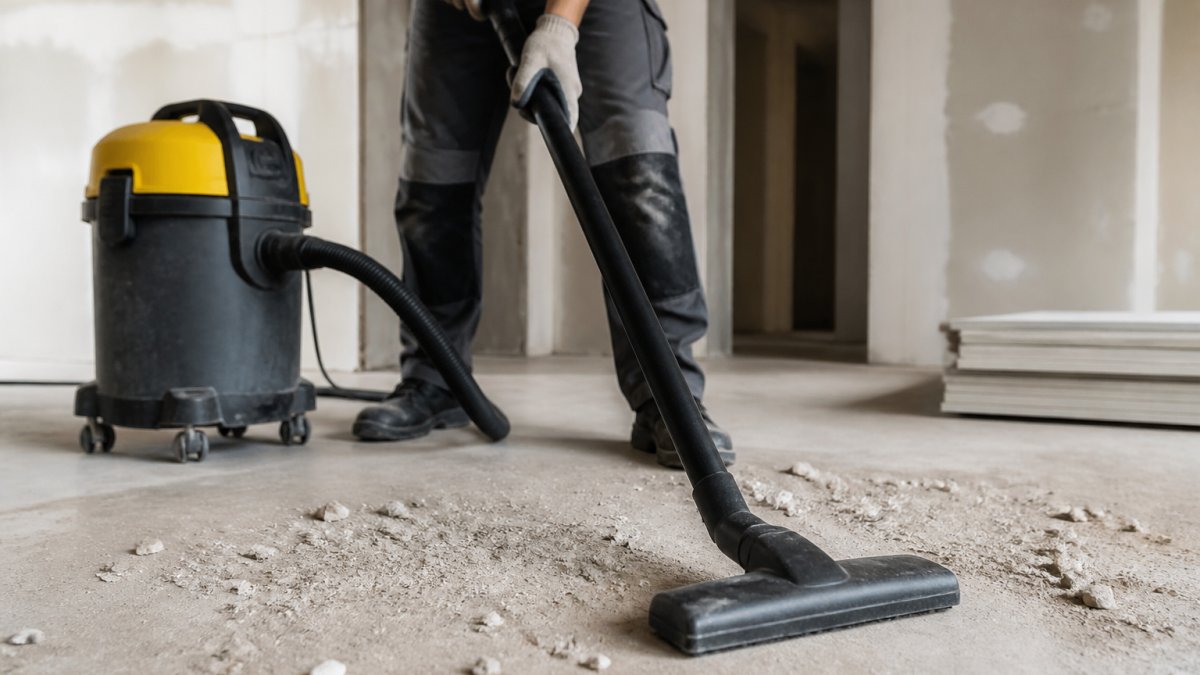
The best vacuum for construction dust is a HEPA-filtered shop vacuum with a sealed system, not a standard household canister or upright. Drywall dust and silica particles pass through standard bags and filters, and a non-sealed vacuum pushes that fine fraction out through seams and the exhaust, redistributing it across the room you just cleaned.
What 'HEPA' actually means on a vacuum
A true HEPA filter captures 99.97% of particles at 0.3 microns, but only if the entire air path is sealed. Look for three things on the label:
- HEPA-rated exhaust filter (not just a 'HEPA-style' or 'HEPA-type' media)
- Sealed system, gaskets at the canister, hose, and motor housing so dust cannot bypass the filter
- A pre-filter or bag stage ahead of the HEPA media, so the HEPA filter is not doing the heavy lifting on coarse debris
A vacuum that says 'HEPA filter included' but has an unsealed canister will still leak fine dust. If the manufacturer does not state 'sealed system' or 'HEPA filtration' together, assume it is not a true HEPA vacuum.
Shop vacuum vs. household HEPA vacuum
| Factor | HEPA shop vacuum | Household HEPA vacuum |
|---|---|---|
| Fine-dust capture | Designed for drywall and silica loads | Adequate for light touch-up only |
| Canister capacity | Large; fewer empties | Small; clogs quickly on heavy dust |
| Hose reach | Long, often 7-10 ft, reaches ceilings and vents | Short; ladder work is awkward |
| Filter cost | Replaceable, moderate | Often proprietary and pricey |
| Best use | Whole-room and whole-home cleanup | Spot cleaning after the heavy work is done |
For a single bathroom remodel, a household HEPA vacuum is fine if you empty the canister outside and change the filter afterward. For whole-home drywall dust, a shop vacuum with a HEPA cartridge and bag stage saves hours.
Sizing and airflow
A shop vacuum for construction dust should move enough air to lift fine particles without blowing them around. Contractors commonly use a 6-12 gallon unit with a 1.5-2.5 peak horsepower motor and a hose at least 7 feet long. Match the canister to the job, small for touch-ups, mid-size for room-by-room work, large only when you empty frequently.
Filter maintenance that actually matters
- Empty the canister when it is about half full. A full canister reduces airflow and forces dust past the pre-filter.
- Tap, do not blow, the HEPA cartridge. Compressed air damages the pleats and voids the rating.
- Replace the HEPA cartridge when airflow drops noticeably or when the pleats are visibly loaded, not on a fixed calendar.
When a standard household vacuum spreads dust
A standard vacuum spreads fine dust when the exhaust filter is not HEPA-rated, the canister or hose connection is loose, the bag is overfilled, or the unit is bagless with a dirty pre-filter. If you only have a household vacuum, restrict it to post-cleanup touch-ups, empty it outside, and follow with a damp microfiber wipe.
Avoid dry-sweeping as a substitute. A broom lifts the fine fraction back into the air, where it resettles on surfaces you already wiped. Vacuum first, then damp-wipe.
Top-to-Bottom Cleaning: Ceilings, Walls, Floors, and Glass
Work from the ceiling down, and you will only clean each surface once.
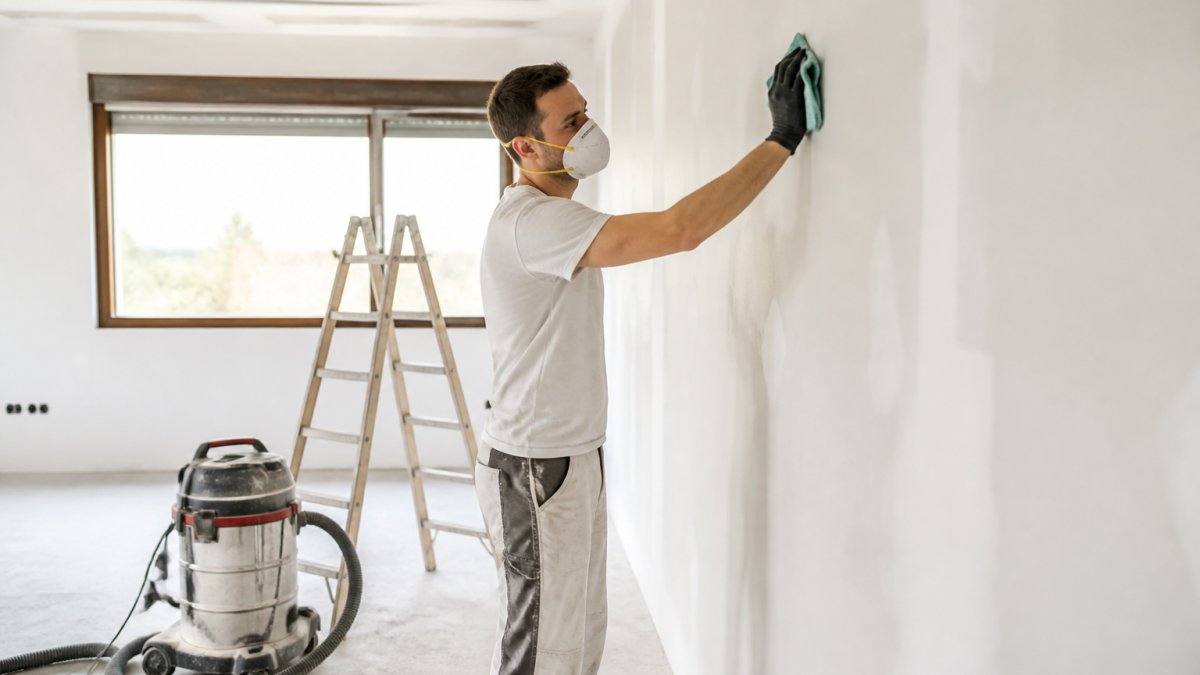
Ceilings and high surfaces. Use a vacuum with a brush attachment or a microfiber cloth on a pole.
Walls and trim. Drywall dust clings to walls.
Windows and glass. Use a damp cloth first, then a squeegee or dry cloth.
Floors. Vacuum first, then mop. Mop twice for heavy dust, rinsing the mop often.
For a structured walkthrough of each room, our room-by-room move-in and move-out cleaning guide breaks down the order for kitchens, baths, and bedrooms.
How Long Does Construction Dust Last, and How Do You Know You're Done?
Construction dust can linger for weeks: the fine fraction (drywall powder, silica, sawdust fines) settles slowly, and foot traffic, pets, doors, and HVAC cycles lift it back into the air. A single pass is almost never enough. Most homes need repeat cleaning over the first one to two weeks, with a lighter touch-up after that.
A realistic repeat-cleaning schedule
| Timing | What to do |
|---|---|
| Day 0 (heavy cleanup day) | Full top-to-bottom pass: debris, air cleaning, high surfaces, mid surfaces, floors, glass |
| Day 1 | Vacuum floors and damp-wipe horizontal surfaces; check HVAC filter |
| Day 3 | Vacuum floors, wipe sills and cabinet tops, check filter color |
| Day 7 | Full light pass; replace HVAC filter if it has grayed |
| Day 14 | Touch-up pass; confirm completion checks below |
| Monthly for 2-3 months | Vacuum floors and wipe horizontal surfaces; watch for dust puffs |
Adjust the schedule to the project. A single bathroom remodel may only need the Day 0 and Day 3 passes. A whole-home renovation with heavy drywall work often needs the full two-week sequence plus monthly touch-ups for a few months.
Observable completion checks
Use these checks together, no single one is sufficient:
- White-cloth wipe. Wipe a dark surface (a door top, a cabinet shelf, a window sill) with a clean white microfiber cloth. A clean cloth with no gray or white residue is a pass. Repeat on three surfaces in different rooms.
- Filter color check. Note the color of a new HVAC filter when you install it. If it visibly grays within 3-5 days of normal living, dust is still circulating and air cleaning is not finished.
- Walk test. Walk firmly across a hard floor in a dark room with a flashlight held low and parallel to the floor. Visible puffs or a haze in the beam mean dust is still on the floor.
Why dust keeps coming back
If dust returns after a full pass, the cause is usually one of four things:
- Air cleaning is undersized or not sealed. A scrubber with a loaded filter or loose seal recirculates dust rather than removing it.
- HVAC is spreading dust. Change filters, seal returns during heavy work, and run the fan continuously during cleanup.
- Containment failed. Loose sheeting, an open door, or an unsealed doorway lets dust migrate from unfinished zones into clean ones.
- Dust is trapped in soft goods and joinery. Vacuum upholstery and curtains with a brush attachment and wipe cabinet interiors and door tracks with a damp cloth.
When to stop DIY and call a pro
If dust keeps returning after two full weeks of scheduled passes, or the white-cloth test fails in multiple rooms despite repeat cleaning, the source is likely containment or HVAC contamination rather than surface dust. A professional assessment is then cheaper than repeated DIY passes. The same is true if anyone in the home has respiratory sensitivity, if the home was built before the 1980s and painted surfaces were disturbed, or if joint compound or concrete was sanded or cut without containment.
DIY or Hire a Professional Post-Construction Cleaning Service?
DIY cleanup works for small projects like a single bathroom remodel. For whole-home renovations, heavy drywall dust, or a tight move-in deadline, a professional crew saves days of work and protects your lungs.
Consider hiring a pro when:
- Dust covers multiple rooms or floors
- Cabinets, vents, and fixtures are packed with fine dust
- You need the space spotless for a walkthrough or inspection
LSC Omaha Cleaning handles post-construction cleanup as a specialty, with detail-oriented crews and flexible scheduling that fits your contractor's timeline. If you are weighing costs, please contact us for a customized quote.
Frequently Asked Questions
What is the best way to clean post-construction dust?
Work top to bottom and dry before wet. Start with a HEPA vacuum on ceilings, walls, and vents, then damp-wipe surfaces with microfiber cloths, and finish with floors. Use a HEPA-filter vacuum rather than a shop broom, since sweeping just pushes fine drywall dust back into the air. Change HVAC filters after the heavy dust phase, and run an air scrubber or purifier with a HEPA filter to pull airborne particles down. Repeat the cycle until cloths come up clean.
How long does construction dust last after a renovation?
Visible dust settles within a few days, but fine particles can keep recirculating for weeks if the HVAC system and soft surfaces aren't cleaned. Expect two to three full cleaning passes over the first week, then follow-up wipe-downs for another two to four weeks. Replacing HVAC filters and vacuuming vents shortens the timeline. If dust keeps reappearing on surfaces you already cleaned, the source is usually the ductwork or filter, not the room itself.
What is the best vacuum for construction dust?
Look for a vacuum with a sealed HEPA filtration system and a rated filter, not just a HEPA-style label. A commercial-grade canister or shop vacuum with true HEPA filtration traps fine drywall and silica particles instead of blowing them back out. Check that the filter is washable or replaceable and that the unit has strong suction at the hose end. Avoid standard household vacuums, which can clog and release fine dust through their exhaust.
Can construction dust damage furniture or electronics?
Yes. Fine drywall dust is abrasive and gets into vents, keyboards, and motor housings, where it can cause overheating and scratches on finished surfaces. Cover furniture with plastic sheeting before work starts, vacuum upholstery with a brush attachment, and wipe electronics with a dry microfiber cloth rather than a wet one. Move smaller items out of the work zone entirely. Cleaning soft surfaces early prevents dust from being pushed deeper into fabric.
Construction dust cleanup is a test of patience more than muscle. Protect your lungs, clean the air first, and work top to bottom. If the mess feels bigger than a weekend project, LSC Omaha Cleaning can take it off your list with post-construction cleanup, deep cleaning, and window washing backed by over a decade of experience. Get started with LSC Omaha Cleaning and walk into a genuinely dust-free home. For more tips, browse our residential cleaning blog.
